







Executives across the rug sector point to a measured reality: AI and data tools are accelerating workflows and improving communication, while craftsmanship and human judgment remain central to the business.
With rug suppliers operating in a retail climate defined by cautious inventory positions and continued cost discipline, the emphasis has increasingly shifted toward productivity and precision. Artificial intelligence, despite its ubiquity in broader business dis course, is finding a distinctly practical foothold within the rug industry.
For manufacturers and importers, AI is less about reinvention and more about working faster, simplifying workflows, and easing the burden of expanding administrative, production, and marketing demands.
RUG INSIDER recently interviewed several key industry executives from a cross-section of area rug companies and discovered a shared perspective: AI is increasingly present, its value judged by utility rather than novelty.
Where AI Is Quietly Showing Up
For Dalton, GA-based Oriental Weavers USA, AI has already become embedded across core business functions. “AI is increasingly becoming part of everyday life, and its value in the business world continues to grow,” said Andy Brumlow, president. “We are using AI to stream line multiple aspects of our operations—from graphics and design to marketing, customer communication, and day-to-day execution.”
Founded in 1991, Oriental Weavers USA is the American division of Cairo-based global giant Oriental Weavers, manufacturer of machine-woven area rugs and carpets.
AI is increasingly becoming part of everyday life, and its value in the business world continues to grow.
ANDY BRUMLOW, PRESIDENT, ORIENTAL WEAVERS USA
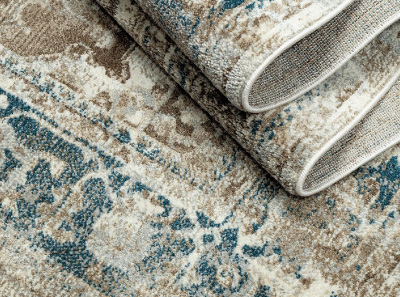
Rather than positioning AI as disruptive, Brumlow credited it with enhancing responsiveness and efficiency. “These tools allow us to work smarter, move faster, and ultimately become a stronger, more responsive supplier to our customers. The evolution is just beginning, with new AI capabilities and strategies emerging almost daily.”
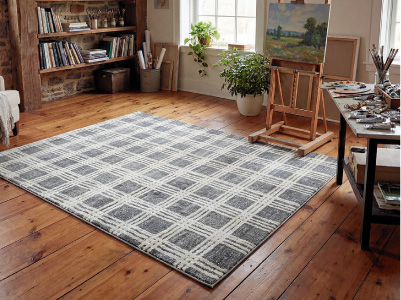
This framing—AI as an enabler rather than an overhaul— reflects how many rug companies are approaching the technology.
Speed, Efficiency and Small Gains
Across conversations, executives consistently point to time savings and workflow improvements as AI’s most immediate benefits.
At Dynamic Rugs, current AI use is targeted but meaningful. “At this stage, our use of AI is limited but purposeful,” explained Brandon Barker, director of marketing.
Established in 1994 and based in Frederick, MD, the company is a supplier of diverse, fashion-forward area rugs for residential and commercial spaces. Dynamic’s selection spans imported machine-made and hand-tufted products from Turkey, India, Belgium, and China.
When it comes to AI, Dynamic Rugs primarily uses AI to refine written communication, generate room scene visuals and improve lower-resolution factory photography, Barker noted. “These tools have helped improve efficiency, particularly on the marketing and administrative sides.”
Image enhancement reduces the need for costly reshoots, while AI-assisted writing helps streamline communication and maintain consistency across customer-facing messaging. And the gains here are practical: clearer visuals, faster turnaround and reduced production friction.

Supporting Decisions, Not Replacing Judgment
For Kaleen, AI functions primarily as a filtering and analytical aid, COO Monty Rathi explained. “We use AI in a focused way for supplementation in research, marketing, and data analysis.”
In business for over 50 years with headquarters in India with U.S. operations in Dalton, GA, the company manufactures and designs handcrafted area rugs and broadloom carpets.
Today, AI tools assist Kaleen with evaluating demand patterns, category performance and market trends that inform planning decisions for custom rugs and broadloom.
“AI is a tool that helps us sort and filter through data points, more than anything,” Rathi said. “While AI is nice to speed through some phases, it still comes down to our team and their years of experience to make the final judgments.”
AI improves speed and clarity in evaluating information, but not the core decision-making process, he added. “These tools help us analyze information faster, improve forecasting inputs, and make planning decisions with more clarity.”
The distinction remains clear across companies: AI informs. People decide.
Planning, Forecasting and Risk Reduction
Several executives cited AI’s growing usefulness in preproduction decision-making and early development workflows.
At Nourison, AI has proven valuable in concept exploration and visualization inspiration. “At this stage, we primarily use AI as a creative and efficient tool in the early phases of development and marketing,” Alex Peykar, principal, told RUG INSIDER.
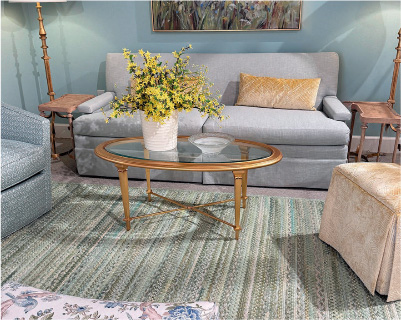
But for asset production, the company relies on controlled CGI environments rather than fully AI-generated imagery to ensure consistency, accuracy, and production depend ability, he stressed. “AI has helped accelerate early-stage visualization and reduce turnaround time for concept development. This allows our teams to evaluate ideas more quickly, streamline workflows, and make more informed decisions earlier in the process.”
AI has helped accelerate early-stage visualization and reduce turnaround time for concept development. This allows our teams to evaluate ideas more quickly, streamline workflows, and make more informed decisions earlier in the process.
ALEX PEYKAR, NOURISON
Still, Peykar underscored that AI remains an upstream tool. “AI has not replaced hands-on craftsmanship, technical expertise, or quality control within our domestic custom and broadloom operations.”
Domestic Manufacturing Meets Digital Tools
In the manufacturing of braided rugs and accessories—one of the most tradition-anchored segments of the industry— AI’s role is more measured.
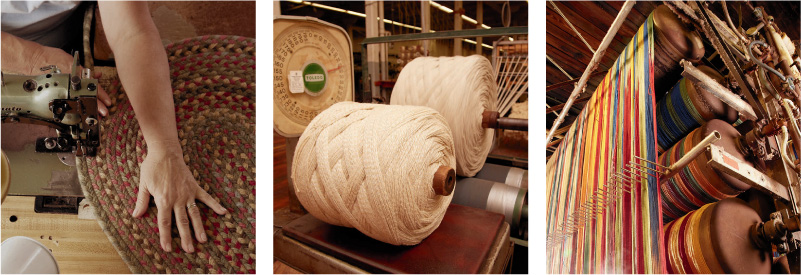
At Capel Rugs, legacy processes proudly remain central. “Manufacturing braids is pretty low-tech, and we still use machinery that my grandfather used,” said Cameron Capel, president of sales and marketing.
And she views this method as an advantage. “We make them the same way as we did 100+ years ago, with the same excellent quality and handcraftsmanship.”
Founded in 1917 by A. Leon Capel in Troy, NC, the company is a historic, family-owned manufacturer and importer known for pioneering the modern braided rug. In addition to these qualities, it also offers hand-knotted and machine-made rugs.

While AI itself is not heavily integrated, digital systems have improved reporting and operational visibility, Capel said regarding technology’s impact on workflow efficiency. As such, the company embraces technology where it is beneficial while maintaining a strong human presence throughout production.
“Every rug is hand signed by the sewer. We don’t want to remove the human part of these handcrafted rugs,” she noted.
Rhody Rug, which claims to be the largest braided rug manufacturer in the U.S. following its acquisition of Colonial Mills in September, reflects a similar production philosophy. While the company has adopted AI selectively in visual and customer-facing workflows, manufacturing itself remains intentionally traditional.
As President and CEO Scott Weldon explained to RUG INSIDER, existing equipment, though older, continues to perform reliably—reinforcing the company’s preference for stability and hands-on craftsmanship over unnecessary technological disruption.
AI’s Role in Customer Interaction
For some companies, AI’s most visible contributions appear not in manufacturing but at the customer interface.
Rhody Rug has adopted AI selectively in customer-facing workflows. Current uses include photography, visual setting and website inquiry responses designed to improve speed and consistency.
“We’re using AI in very specific ways—primarily for visual presentation and to help manage website inquiries more efficiently,” Weldon said. “It allows us to respond faster and maintain consistency, particularly outside normal business hours. That said, AI is not part of our manufacturing process. Our equipment is older but performs well, and braided rug production remains a hands-on operation.”
The objective is straightforward: faster replies when staff are unavailable. AI supports initial communication, while personal follow-up remains essential. “We are still one of the few companies left that answers our phones,” Weldon said. “You will get me or someone else here when you call.”
Back-Office Efficiencies Add Up
Beyond design and marketing, executives note AI’s growing presence in documentation, reporting and administrative support.
Rathi observed that AI-supported research and documentation workflows help teams capture and share knowledge more consistently, supporting onboarding and continuity across roles.
Peykar similarly cited AI’s usefulness for documentation and internal knowledge sharing, making institutional knowledge easier to access.
These applications may lack visibility, yet their impact is tangible—less ambiguity, fewer revisions and smoother workflows.
Where AI Still Has Limits
Despite growing adoption, executives uniformly caution that AI’s usefulness remains highly context-dependent.
Rathi was unequivocal regarding handcrafted production: “With that level of artisanship, AI does not make sense in our weaving, tufting, or production process. The physical making of our broadloom and custom rugs requires skilled human judgment, technique, and hands-on quality control that technology does not replace.”
Peykar echoed this boundary. “Physical production, material selection, and finishing still require experienced teams and in-person oversight.”
Barker added that AI has not been integrated into core manufacturing, quality control or custom fabrication decisions at Dynamic Rugs.
A Technology of Refinement
Unlike industries pursuing disruption narratives, rug manufacturers appear focused on incremental improvements.
Speed, efficiency, consistency and clarity—these are the attributes Mahurter sees as part of AI’s evolution and opportunistic value.
“We are currently using AI to improve our customer service both at the consumer and dealer levels,” said Larry Mahurter, senior vice president of marketing and advertising at Couristan.
Celebrating its centennial this year, Couristan is a family-owned-and-operated company that specializes in manufacturing and importing a wide range of high-quality area rugs, residential carpeting, and custom floor coverings.
The greatest aspect of using AI is that it is constantly evolving, and new opportunities to improve upon customer relations, efficiencies and performance is truly exciting.
LARRY MAHURTER, SENIOR VICE PRESIDENT OF MARKETING AND ADVERTISING, COURISTAN
Mahurter continued: “The greatest aspect of using AI is that it is constantly evolving, and new opportunities to improve upon customer relations, efficiencies and performance is truly exciting.”
From a marketing standpoint, he anticipates continued change. “As with all industries, we will see a complete change in how technology improves the sales funnel within companies.”
What Comes Next—Realistically
Executives broadly agree that AI’s role will expand, though unevenly across functions. Most expect continued gains in:
- Visualization and design support
- Marketing and asset production
- Data sorting and analysis
- Customer communication
- Documentation and reporting
At the same time, core production disciplines—craftsmanship, finishing, quality control and material judgment — remain firmly human-led.
Across all voices, one principle remains firm: AI may accelerate processes. It does not replace expertise.
IMAGES COURTESY OF: CAPEL RUGS, DYNAMIC RUGS, KALEEN, NOURISON