


The rug business has always depended on trust. Customers place that trust carefully, often after long consideration, because the products we sell are not disposable. A well-made rug is meant to last decades, sometimes generations. That durability is part of the value proposition, but it also creates a quiet challenge for retailers: once the sale is complete, there is little reason for the customer to return.
This is not a failure of retail. It is a structural reality of the category. Rugs do not wear out quickly, styles do not change overnight, and most customers are not constantly shopping for replacements. Without an ongoing reason to engage, even the best relationships fade into the background. A showroom becomes a memory rather than a destination.
Rug washing changes that dynamic.
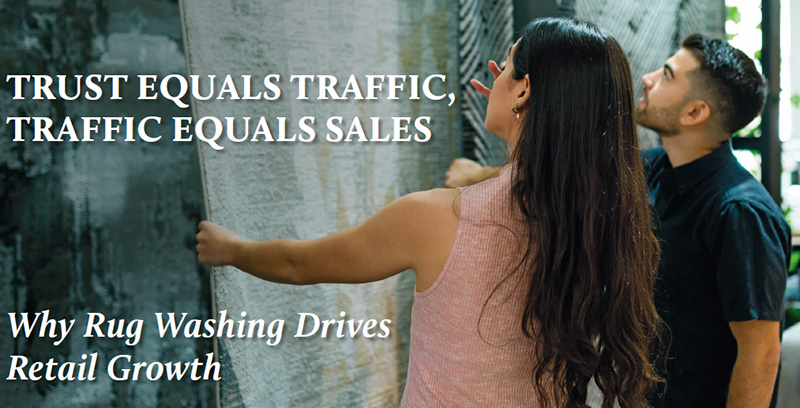
When done correctly, professional rug washing creates repeat traffic rooted in trust, not promotions. It gives customers a legitimate reason to return and gives retailers a way to remain relevant long after the initial sale. In retail terms, trust becomes traffic, and traffic becomes sales.
The core issue facing most rug retailers is frequency. A customer might buy a rug once every ten or fifteen years. Even households with multiple rugs may only purchase occasionally. In the absence of a service relationship, years can pass without contact. During that time, people move, remodel, add pets, have children, or simply change how they use their homes. When a new need eventually arises, the original retailer may no longer be top of mind.
Professional rug washing shortens that gap. Most quality rugs benefit from cleaning every one to three years. That cadence alone transforms the relationship. Instead of seeing a customer once per decade, the retailer now sees them regularly. Familiarity builds. Conversations continue. The business stays present.
What makes this kind of traffic valuable is that it is earned, not manufactured. Customers are not coming in because of a sale or a discount. They are coming in because they care about something they already own. They are thinking about preservation, cleanliness, and long-term value. This mindset is very different from that of a price-driven shopper, and it leads to better interactions on both sides of the counter.
There is also a natural psychological transfer of trust that occurs when retail and care are paired. If a customer trusted a retailer enough to purchase a valuable rug, that trust almost always extends to how that rug should be maintained. From the customer’s perspective, the retailer understands the rug’s materials, origin, and construction. They believe the retailer has a vested interest in protecting that investment. As a result, the decision to use the retailer for cleaning feels logical and safe.
This trust-based service relationship deepens with each visit. Over time, the retailer gains insight into how the rug is actually being used. Changes in lifestyle become visible. A family might now have pets. A formal room might have become a playroom. Furniture may have shifted. Homes change, and rugs change with them. These moments create context that cannot be replicated by one-time transactions.
Retail opportunities that arise from these interactions tend to feel natural rather than forced. A worn pad is noticed during intake. A rotation is recommended. A repair becomes necessary. In some cases, a new rug for a different space becomes part of the conversation. These are not upsells in the traditional sense. They are solutions grounded in observation and familiarity.
Pricing plays a critical role in sustaining this model. Many retailers make the mistake of underpricing rug washing in an attempt to drive volume. This often undermines trust rather than building it. Customers who have invested significantly in rugs are not looking for bargain care. In fact, unusually low pricing can create doubt about process, training, and attention to detail. Premium rugs require premium handling, and customers understand that.
Charging appropriately for professional washing does more than protect margins. It aligns expectations. It signals that care will be taken seriously and that the process is designed for preservation, not speed. In markets where this is communicated clearly, customers accept higher pricing because it matches the value of what they are protecting.
It is also important to recognize that offering rug washing does not require a retailer to do everything in-house. Operating a wash facility is complex. Water systems, waste management, labor, training, insurance, and space all introduce operational risk. For many retailers, the smarter path is partnership. What matters most to the customer is accountability, not ownership of equipment. They want to know who stands behind the work.
By partnering with a specialized rug washing facility, retailers can offer professional care without overextending their operations. The retailer remains the trusted point of contact. The washing partner becomes an extension of expertise. From the customer’s perspective, the experience feels seamless and professional.
Over time, the benefits of this approach compound. Customers who return regularly for cleaning become long-term relationships rather than one-time buyers. They refer friends. They trust recommendations more readily. They are more likely to return to the same retailer when a new purchase is needed. The business becomes part of their household rhythm rather than an occasional stop.
The long-term health of a rug retail business depends on staying relevant between sales. Products may last a lifetime, but relationships do not maintain themselves. Services do that work quietly and consistently.
Rug washing, when positioned as professional care rather than convenience cleaning, gives retailers a sustainable way to increase meaningful traffic. Trust brings customers through the door. More visits create more opportunities to serve. And over time, those opportunities translate into sales that are rooted in confidence, not persuasion.
In an industry built on longevity, growth does not come from selling more often. It comes from showing up more often.
Beau Burdett is the Owner and CEO of Kirishian Imports & Rug- Spa in Spokane, Washington, a rug retail and specialty cleaning company with more than a century of history. He works alongside a team with over 50 years of combined experience in rug identification, washing, and repair, caring for hand-knotted, silk, and antique rugs from across the region. Beau is passionate about preserving traditional craftsmanship and helping the industry protect rugs that are meant to last generations.